Managing IT in-house sounds efficient until your network crashes at 2 AM and you're the only one who knows the passwords. We're breaking down why outsourcing IT support isn't just convenient—it's actually cheaper, smarter, and way less stressful than trying to do it yourself.
Why Your Business Shouldn't DIY IT Support (And What Happens When You Do)
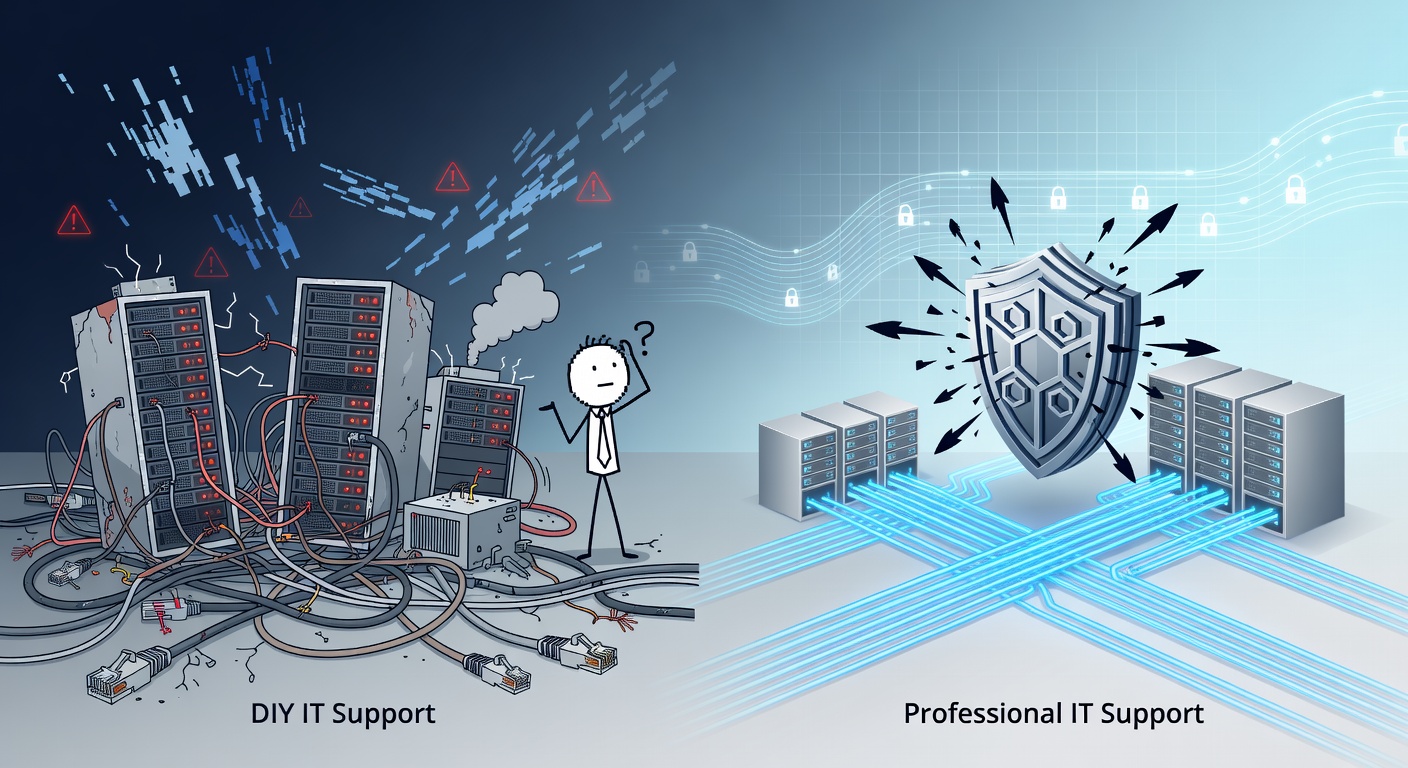
Why Your Business Shouldn't DIY IT Support (And What Happens When You Do)
Let's be honest: your business didn't get successful because you're amazing at fixing servers. You got successful because you're amazing at your thing—whether that's selling products, delivering services, or leading a team.
So why do so many businesses treat IT like a side hustle? It's usually because they think managed IT support is expensive, or they've convinced themselves that "we've handled it this long without help." But here's the reality nobody talks about: DIY IT is bleeding money you don't even realize you're losing.
The Hidden Cost of Doing IT Yourself
When your IT person wears five hats—network admin, security officer, helpdesk support, and whatever else—nothing gets done well. That talented employee who should be driving revenue? They're instead stuck resetting passwords and chasing down malware alerts.
Every hour spent on IT problems is an hour not spent on growing your business. That's opportunity cost, and it adds up fast.
But the real nightmare? Downtime.
When your network goes down at 3 PM on a Tuesday, you're not just inconvenienced. You're losing money every single minute. If you have an in-house IT person, they might be in back-to-back meetings or already dealing with three other emergencies. Response time? Could be hours. In-house IT teams are like fire departments that only work 9-to-5.
Cloud services down? Email broken? That critical database inaccessible? Hope you have good coffee, because you're waiting.
The Security Elephant in the Room
Here's something that keeps business owners up at night (whether they admit it or not): Is someone trying to break into our systems right now?
Running your own IT security is like being a security guard at a concert. You can watch the main stage, but there are 50 exits and entrances you might miss. One employee clicks on a phishing link, one unpatched vulnerability, one stolen credential—and suddenly your entire network is compromised.
Managed IT providers have something you don't: continuous monitoring 24/7/365. They're watching for threats while you sleep, using enterprise-grade tools that cost a fortune to buy and maintain independently. They catch intrusions before they become breaches. They patch vulnerabilities before they're exploited. They detect weird login patterns from impossible locations.
That's not paranoia—that's professional security hygiene.
The Compliance Headache You're Probably Ignoring
If your business handles customer data, takes payments, or operates in regulated industries, compliance isn't optional. It's mandatory.
Compliance audits are terrifying when you're flying by the seat of your pants. You scramble to document processes, gather logs, prove you've been secure, and hope the auditors don't find anything scary. It's like cramming for a final exam, except the "grade" determines whether your business stays operating.
Managed IT providers have compliance down to a science. They build it into everything they do from day one. Annual audits? They're prepared. Compliance reporting? Already documented. SOC II, HIPAA, PCI-DSS, GDPR—they speak the language and have the certifications to prove it.
You stop worrying about compliance because someone competent is actually handling it.
When Your Business Outgrows Your IT
Growth is exciting until your infrastructure can't handle it. You hired 50 new people, opened a second office, moved more workloads to the cloud—and suddenly your IT is screaming.
DIY IT doesn't scale. Your in-house person is drowning. You'd need to hire more IT staff, train them, manage them, and pray they don't quit. That's expensive, slow, and full of risk.
Managed IT providers build scalable systems from day one. They design cloud environments that grow with you. They add capacity before you even realize you need it. They integrate new locations seamlessly. It's like having an experienced IT architect on your team who's already solved these problems 100 times.
The Human Connection Nobody Expects
Here's something surprising: the best managed IT providers actually know your business.
They're not ticket-number-obsessed robots sending you templated responses. They know your company culture, your critical systems, your deadlines, and the people who depend on your network. When something goes wrong, they don't start from zero—they already understand your environment.
That relationship matters more than you'd think. Instead of explaining your entire setup every time you call, they remember. Instead of recommending overkill solutions, they recommend what actually works for your business. Instead of treating you like a transaction, they treat you like a partner.
So What's the Real Deal?
Managed IT support isn't a luxury expense. It's the opposite—it's cost prevention. You're paying a predictable monthly fee instead of:
- Losing productivity to IT disasters
- Paying premium rates for emergency IT repairs
- Getting hit with security breach costs
- Risking compliance violations and fines
- Burning out your best people on tech support
- Struggling to scale your infrastructure
It's like the difference between getting regular car maintenance and waiting for your engine to explode on the highway. One is preventative, smart, and affordable. The other is reactive, expensive, and stressful.
The Bottom Line
Your business has better things to do than manage IT infrastructure. The question isn't whether you can afford managed IT support—it's whether you can afford not to have it.
Stop treating IT like a necessary evil handled by whoever has time. Start treating it like what it actually is: a critical business function that deserves professional attention.
Because the best IT support is the kind you never have to think about. It's there, it's working, and you can focus on what you actually built your business to do.
Tags: ['managed it support', 'business it infrastructure', 'cybersecurity', 'network downtime prevention', 'it outsourcing', 'compliance management', 'cloud scaling', 'business continuity']